FEATURE|Serving All Library Families in a Queer and Genderqueer Way
JOEL A. NICHOLS is an administrator for Data Strategy and Evaluation in the Strategic Initiatives Department at the Free Library of Philadelphia, where he previously worked as a children’s librarian and branch manager. He is the author of Teaching Internet Basics: The Can-Do Guide (2014) and iPads in the Library (2013) both from Libraries Unlimited. Contact Joel at nicholsj@freelibrary.org. Joel is currently reading All the Birds in the Sky by Charlie Jane Anders.
There are lesbian, gay, bisexual, trans, and queer children and families in every service community in the country. While libraries all across the country serve queer people in various ways, most likely still rely on heterosexuality and cisgender as defaults. That is, the norms that govern straight people, normal families, and people whose gender expression matches their birth sex.
There are excellent resources for librarians who want to improve their services to LGBTQ patrons, and the American Library Association’s (ALA) Gay, Lesbian, Bisexual and Transgender Round Table (GLBTRT) collects, creates, and promotes professional resources, and, importantly, administers the Stonewall Book Awards and yearly booklists that share the most current materials. See those, and more, at ala.org/glbtrt. It is worth noting that the GLBTRT started as the Gay Task Force of ALA, and was the first gay or lesbian professional organization in the United States. I have also met many queer library workers—from library school to my current job; we really are everywhere. But in the fine tradition of providing neutral information, the ways even queer library workers interact with the public, in my experience, remain governed by heteronormative defaults. While our job is to find and present authoritative sources from multiple perspectives, I urge us to feel out the by-definition limits of operating within a larger system of authority that treats gender in a strict binary and defaults to homonormativity. For a deeper analysis of this from a cataloging perspective, see Emily Drabinski, K.R. Roberto, and Amber Billey’s “What’s Gender Got to Do With It? A Critique of RDA Rule 9.7” in Cataloging and Classification Quarterly from April 2014.
It is useful to start with the terminology itself. For me, queer is serving as an umbrella term for gay, lesbian, bisexual, or trans. It could also include other sexual minorities, such as asexuals or other people who are gender variant. But I’m also using it as a political term that embodies political resistance to heterosexist assumptions. This also means feminist, anti-racist, anti-classist, and so on.
Gender is social and cultural norms that govern our lives about masculinity and femininity, about what is masculine and feminine, about what is appropriate for men and women and girls and boys. And gendered, as I will use it here, means assigning gender characteristics to things like toys, books, themes, appearance, and behavior.
Sex means biological sex, referring to sex organs or chromosomes, and cis refers to someone who presents a gender identity that matches their birth/biological (or assigned) sex, i.e., not trans. Trans is short for transgender, which is someone who presents a gender identify that might not match their birth/biological sex, i.e., not cis. The term “transsexual” is now obsolete and any delineation between transsexual and transgender or transgendered is not worth distinction in this forum. Transgender or trans serves as a pretty good umbrella term.
Genderqueer is a complex term, better defined in this passage from the website GenderQueerId to offer the specificity needed:
both man and woman (example: androgyne); neither man nor woman (agender, neutrois, non-gendered); moving between two or more genders (gender fluid); third gendered or other-gendered (includes those who prefer “genderqueer” or “non-binary” to describe their gender without labeling it otherwise); = those who “queer” gender, in presentation or otherwise, who may or may not see themselves as non-binary or having a gender that is queer.1
Genderqueer, as a term and as a method, allows librarians to consciously understand and act within our expertise and experience serving children and families. It also offers ameliorative solutions to the harm-gendered assumptions about reading, literacy, and library services. Children who are trans or gender variant are particular objects of bullying and discrimination, including many recent cases about the right of trans students to use the appropriate bathrooms and locker rooms. In a blog post called “Mama, Ella has a Penis,” Marlo Mack lists some bullet points that are useful for talking to kids about gender identity, including, “Some people feel like boys but they really like ‘girl stuff’” and “some people feel like girls but they really like ‘boy stuff.’”2 This advice also includes obvious messages such as, no one needs to know or ask about your private parts. I recommend that people working with children read the post in its entirety for practical and hands-on language you can use with children and families. Trans people and trans kids falsely and reprehensibly remain a threat in the eyes of communities all over and have become targeted by what a congressional forum described as an “epidemic of violence.”3
If we are in this epidemic, and the high-profile suicides of young people like Tyler Clementi4 suggest that anti-queer bullying demonstrates serious harm, there is more that public libraries and librarians can do than have materials and resources available. They should be approaching a level of public service constructed to serve all patrons with dignity and respect, and one way to step up that game is for queer people is to start using queerness as a default mode. This can be a challenge for librarians who rely so much on authoritative structures of knowledge. As Marvin Taylor eloquently articulated in 1993, queerness represents a disruption of authority and is a deliberate confusion of the neat categories we use to understand the world.5 And genderqueerness is an additional dimension of ambiguity and plays in this disruption.
There are concrete steps any public library can take to minimize the confusing or distressing aspects of these ambiguities, while improving services to all patrons and visitors at the same time. One is making sure that their data collection instruments, especially library card applications, are designed in ways that erase barriers for people whose government-issued IDs might not match their physical characteristics or preferred names. In thinking about applying “queerness” as a default for library card registrations, it is possible to build in stronger bridges to access for formerly incarcerated people who might not have an ID, for homeless people who might not have an address, or for libraries where family accounts are linked—loosening up and broadening the constellation of relationships that a library considers family.
Another important part of the library card application is whether or not you ask for a form of address/salutation (Mr., Ms., Mx., etc.) at all, and if you do whether it is important to include options like Mrs. that designate a woman is married, or options like Mx. that are not gender marked. Could it be enough to have people write in their own, or do away with them altogether and always address library communications with “DEAR FIRSTNAME LASTNAME” in a mail merge? I think so. Many applications also ask for gender or sex. If yours does, you should add a preferred pronoun field, so staff can see if a patron has checked off “he, she, they, ze” or written in another option.
How does your library use this gender data? Do you plan outreach and marketing campaigns for men if women borrow more materials at a given branch? If 75 percent of your children’s circulation is from girls, do you double down and only buy “girl” materials to serve this community need, or is that an indication to buy “boy” materials? Would your collection development policy reflect which materials are appropriate for boys and which for girls? I propose that they would not and that most librarians selecting books would not limit themselves and their collections in these ways. I would argue, then, that there are not meaningful ways of using data that assigns gender categories, and offering only male and female as options can alienate and exclude queer and trans people.
It is worth mentioning that there is a library and educational industry around boys as reluctant readers, so there might be books in your collection such as Deborah B. Ford’s Scary, Gross, and Enlightening: Books for Boys Grades 3–12 (Libraries Unlimited, 2010), or you might swear by Jon Sciezska’s Guys Read website and campaign. These efforts presume that some boys are not achieving well in school because teachers and librarians (who are mostly women) are offering them books that are not interesting to them (because they are boys). I find this premise illogical and impracticable, in particular because I am queer: the things that were supposed to interest boys did not necessarily interest me, and the things that were supposed to interest girls sometimes did. Additionally, after years of working in children’s departments, I found over and over again that lots of different things interested lots of different kids. In my experience, it was the parents that sometimes asked for “boy books” or “girl books.” The premise that boys need special “boy” topics shortchanges librarians and the children themselves, and can alienate kids who are queer or genderqueer. See Scott’s “Deconstructing the ‘Books for Boys’ Discourse” for a scholarly analysis of this topic.6
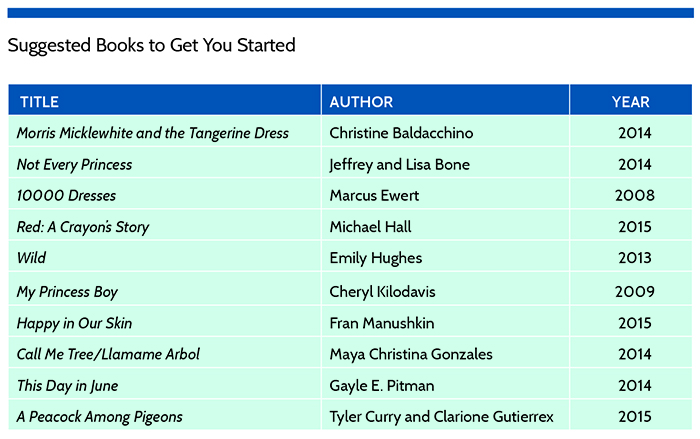
Matching kids and books in a gender neutral way is a way to serve everyone better, as a default. Many of the children you serve might be trans or queer. Some of them could realize it already and perhaps even be ready to come out, and very likely many more are somewhere in a long process of self-identification, understanding, and acceptance. And even children who will end up being straight deserve a gender-neutral approach; some little boys are going to grow up and have long hair and paint their fingernails (and be straight!). Actively seeking out books with illustrations, stories, and themes that celebrate individuality and dignity in diversity, including books that do not rely on rigid gender roles, primes librarians to improve their services to kids of different sizes, abilities, ethnicities, classes, and other groups who are not defined by our culture’s version of “normal.” You probably already have these three titles in your collection that do just that: Helen Lester’s Tacky the Penguin, Leo Lionni’s A Color of His Own, and Maurice Sendak’s Where the Wild Things Are. These improved services will also positively affect the adults in their lives.
Another place children’s librarians can take action is during songs, rhymes, and games in storytime. Change the pronouns in familiar songs (Old McDonald had a farm, and on her farm or and on their farm; Five little monkeys jumping on the bed . . . their parent called the doctor and the doctor said, or if “their parent” sounds too awkward, you can commit to constantly switching it up: momma and papa and daddy and baba and grandma and
mommy and auntie, etc.). Avoid asking children to divide (or dividing them) into groups of boys and girls, just as you might avoid asking them to divide into groups of fat and thin or tall and short.
Consider using “they” as an alternate pronoun to he or she. It is a way to neutralize the way you refer to someone whose gender you do not know or do
not recognize, which might help avoid misgendering someone. If someone tells you what their preferred name or preferred pronoun is, please use it. Do not assume that a child is there with their mommy, even if kids usually are. These suggestions are meant to be little, but impactful shifts that will make people feel more welcome and comfortable engaging at their library. A common theme of the narratives of trans people in the book Trans/Portraits: Voices from Transgender Communities is that they are constantly explaining themselves, and being asked or forced to explain their very existence.7 Imagine fielding questions and comments such as, “Why doesn’t your appearance match your photo ID?” “Why did you used to have a different name?” “You are in the wrong bathroom!” “You really look like a boy,” and so on every single day. Even if some of these comments are offered with good intentions, it is probably exhausting. So imagine the impact a library worker could have on someone’s day by assuming that that individual is normal or even default.
New buildings and renovated spaces should add family or gender-neutral bathrooms. Sandburg’s 2014 pamphlet available to download from the GLBTRT of ALA is a valuable resource in planning for gender neutral bathrooms, and for revising existing restroom policy to accommodate gender neutral bathrooms.8 There should be diaper changing tables in or available to every restroom, particularly the ones in and near the children’s area.
Libraries and librarians will experience pushback when they explicitly welcome trans and genderqueer people using these strategies. Laws in several states do or would prevent trans patrons from using their bathrooms of choice.9 Be ready with policies—both personnel policies and public policies—that explicitly let trans and genderqueer people use the restroom facilities they find most appropriate, in the same way you might use a
collection development policy to answer a complaint about a book. Many of the techniques outlined in this article will help you negotiate the stickier and more complicated aspects of serving all library users in a genderqueer or queer way. I encourage you to practice these techniques, practice the new language and words you might use to talk about these issues, and be honest about the ways in which they might make you, your public,
or your coworkers uncomfortable. But I challenge you to engage those feelings in a productive way, and to change those attitudes rather than relying on automatic discomfort or disgust to hide them away. We (and our siblings, children, parents, and friends) are everywhere, and we are relying on you to make sure we are welcomed and exceptionally served by public libraries.
References
- Genderqueer Identities, “What is Genderqueer?” accessed Feb. 16, 2016.
- Marlo Mack, “Mama, Ella Has a Penis,” blog post on Mutha Magazine, Jan. 2014, accessed Feb. 16, 2016.
- Dawn Ennis, “Congressional Forum to Investigate ‘Epidemic of Violence’ Against Trans People,” Advocate.com, Nov. 13, 2015, accessed Feb. 16, 2016.
- Kate Zernike, “Son’s Suicide Leads to Aid for Students,” New York Times, Feb. 1, 2013, accessed Feb. 16, 2016.
- Marvin J. Taylor, “Queer Things from Old Closets: Libraries—Gay and Lesbian Studies—Queer Theory,” Rare Books & Manuscripts Librarianship 8, no. 1 (March 20, 1993): 19–34.
- Denise Scott, “Deconstructing the ‘Books for Boys’ Discourse,” Progressive Librarian no.42 (Summer 2014).
- Jackson Wright Shultz, Trans/Portraits: Voices from Transgender Communities (Hanover, N.H.: Dartmouth College Pr., 2015).
- Jane Sandberg, “Gender-neutral Bathrooms in Libraries,” GLBTRT Resources Committee, Oct. 16, 2014, accessed Feb. 16, 2016.
- Indianapolis Business Journal, “Indiana Bill Targets Transgender Bathroom Use,” Dec. 26, 2015, accessed Feb. 16, 2016; Katy Steinmetz, “States Battle Over Bathroom Access for Transgender People,” Time, Mar. 6, 2015, accessed Feb. 16, 2016; Cleis Abeni, “Mo. Trans Student’s Bathroom Struggle Is History Repeating Itself,” Advocate .com, Sept. 2, 2015, accessed Feb. 16, 2016.
Tags: lgbt youth, LGBTQIA